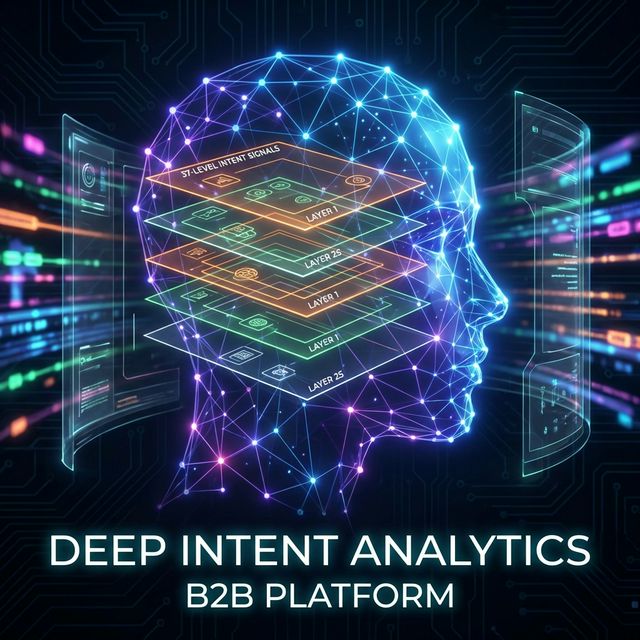
Beyond "First Name": The 37 Intent Signals Your Current SDR Tool Is Missing
Let’s be deeply honest with ourselves for a moment. As revenue leaders, we all know what happens when we open our own inboxes every morning. We mass-delete almost everything.
When we see an email that begins with, "Hey Aditya, I saw you work at IngageNow. We help companies like IngageNow grow..." our brain immediately categorizes it as spam. We don't even finish reading the first sentence.
Yet, this incredibly shallow, mail-merge style of "personalization" is exactly what 90% of B2B outbound teams are still forcing their SDRs to send today. If your SDRs are relying exclusively on basic Firmographic data–Industry, Employee Count, and Estimated Revenue–you are playing a fundamentally losing game.
Buyers are completely blind to surface-level personalization. They know a bot inserted {{Company_Name}}.
The Era of Deep Signal Scrapping
To capture the attention of a busy executive in 2026, you cannot simply prove that you know their name. You need to prove, within the first 3 seconds of them reading your message, that you actually understand their immediate, pressing operational pain.
This is where the traditional SDR model fails, and where IngageNow’s 37-Level Dimensional Analysis fundamentally changes the way outbound sales operates.
An IngageNow autonomous agent doesn't just scrape Apollo for an email address and a job title. It acts as a digital private investigator, actively scanning the open web for behavioral anomalies that indicate a highly active, narrow buying window.
Here are just a few of the granular, "invisible" signals that standard outbound tools completely miss, but our agents leverage daily:
- The Tech Stack Delta: Did the target company just uninstall a major competitor's software from their website architecture yesterday? If so, they are actively ripping and replacing, and their budget is open right now.
- Granular Hiring Velocity: They aren't just "hiring." Are they rapidly opening 4 new positions specifically for mid-level managers in the Implementation department? This indicates massive post-sale onboarding friction–a specific pain point you can pitch against.
- Executive Transitions & The 90-Day Rule: Did a new VP of Marketing join in the last 60 days? Industry data proves that new executives spend 70% of their entire new technology budget within their first 90 days to make their mark. Reaching them on day 45 is critical.
- Social Sentiment Analysis: Have their active employees been vaguely complaining on Twitter or in specialized Slack communities about a specific operational bottleneck?
- Regulatory Exposure: For fintech and healthcare SaaS: Did a new piece of state-level compliance legislation pass yesterday that specifically affects this prospect's exact sub-industry?
The Calculation of Intent
Any single one of these signals is mildly interesting. But an IngageNow agent doesn't look at them in isolation. It uses complex dimensional analysis to stack these signals and calculate a definitive Intent Score.
If the agent sees that a company just raised a Series B (Signal 1), AND they just hired a new VP of Sales (Signal 2), AND they just posted 5 job listings for Salesforce Administrators (Signal 3), the agent mathematically recognizes that this company is actively rebuilding their entire revenue operations infrastructure.
That is not a cold lead. That is a highly qualified, immediate-priority prospect.
The Output: True Bespoke Copywriting
Identifying the signal is only half the battle. The magic happens when the IngageNow LLM synthesizes those hidden signals into a coherent, highly intelligent narrative for the outbound email.
Instead of the generic, "I saw you work at Acme Corp," the agent writes something devastatingly relevant:
"Aditya, I saw Acme just brought on Sarah as the new VP of Sales while simultaneously opening 5 reqs for SFDC administrators. Usually, when teams scale their RevOps headcount that aggressively right after a Series B, they are struggling with severe data hygiene issues in their legacy CRM instance. We automate..."
That isn't a mail-merge. That is an incisive, highly relevant, empathetic observation.
When a buyer receives that email, they do not think, "A robot wrote this." They think, "This salesperson actually took 20 minutes to deeply research my specific corporate situation before reaching out."
Except, the salesperson didn't take 20 minutes. The IngageNow agent did it in 1.4 seconds.
This is the difference between "personalization" and "relevance." Deep signal scrapping allows you to stop selling to a persona, and start solving a specific, real-time problem.