
The Death of the Manual SDR: Why AI Agents Convert 3x Better (And Cost 90% Less)
Published: February 17, 2025 | Updated: February 22, 2026 By: Aditya Sharma, Founding CEO of IngageNow
I walked into a sales floor built for 100 people last week in Bangalore. The room was eerily silent.
Five years ago, this space would've been deafening – gongs ringing after every closed deal, SDRs shouting "Boom!", the frantic clacking of keyboards as reps raced to hit their 80 dials/day quota.
Today? You could hear a pin drop.
Not because the company's failing. They just closed their biggest quarter ever – ₹12 crore in new ARR.
The silence is because the manual SDR model is dead. And if you're still hiring armies of cold callers in 2025, you're not building a sales team. You're building a museum exhibit. (If you want to see the exact framework replacing it, read our B2B Lead Generation Strategy for 2026).
Here's what nobody tells you: The best B2B companies in India aren't replacing humans with AI. They're promoting humans from grunt work to strategic pilots while AI handles the volume game. The result? 3x higher conversion rates at 1/10th the cost.
Let me show you the math that's forcing this shift – and why the companies that resist will be outcompeted by startups spending ₹2.6 lakh/year instead of ₹35 lakh/year on the same outcome.
🎯 Key Takeaways:
- Manual SDR cost in India: ₹35L/year for 8-10 meetings/month (₹30K per meeting)
- AI Agent cost: ₹2.6L/year for 40-60 meetings/month (₹4K per meeting) – 87% cost reduction
- The shift isn't human → AI replacement; it's human → AI augmentation (humans design strategy, AI executes volume)
- Indian B2B companies using AI agents report 6-8% response rates vs 1-2% with manual SDRs (3-4x improvement)
- By 2027, 60% of B2B outbound in India will be AI-first, human-verified (Gartner India SaaS Report 2024)
What Exactly Killed the Manual SDR Model?
The Manual SDR was a sales development representative whose job was simple: send 80 emails a day, make 50 cold calls, book 8-10 meetings a month. Rinse, repeat.
This model worked brilliantly from 2010-2020 when:
- Email open rates were 25-30% (today: 15-18%)
- Cold call connect rates were 8-12% (today: 2-3%)
- Buyers answered unknown numbers (today: 71% ignore unknown callers)
- Competition was lower (today: 15 SaaS tools for every problem)
What changed? Three forces converged in 2023-2025 to make the manual SDR model economically inviable for Indian mid-market companies:
1. The Unit Economics Broke
Let me show you the brutal math of a manual SDR in India (2025) (you can also view our full ROI comparison here):
Total Cost Per SDR:
- Base salary: ₹6-8 lakh/year
- OTE (on-target earnings with commission): ₹10-12 lakh/year
- Tools (ZoomInfo, Outreach, LinkedIn Sales Navigator): ₹3-4 lakh/year
- Benefits, taxes, provident fund: ₹2-3 lakh/year
- Management overhead (1 manager per 8 SDRs): ₹4 lakh/year per SDR
- Office space (Gurugram/Bangalore rent + facilities): ₹1.5 lakh/year per desk
- Onboarding & training: ₹2 lakh (first year)
- Total First-Year Cost: ₹30-35 lakh per SDR
- Ongoing Annual Cost: ₹28-33 lakh per SDR
Output Per SDR:
- Activities per day: 80 (50 emails, 30 calls)
- Working days: 220/year
- Total activities: 17,600/year
- Connect rate: 2-3%
- Conversations: 350-500/year
- Meeting booking rate: 15-20%
- Meetings booked: 60-100/year (5-8 per month)
Cost per meeting: ₹30,000 - ₹50,000
If you're selling ₹5-10 lakh ACV deals (typical Indian mid-market SaaS), you need 5-10 meetings to close one deal. That's ₹1.5-5 lakh in SDR cost per closed deal – before factoring in sales team costs.
The math only works for enterprise deals above ₹50 lakh ACV. For everyone else, it's a cash furnace.
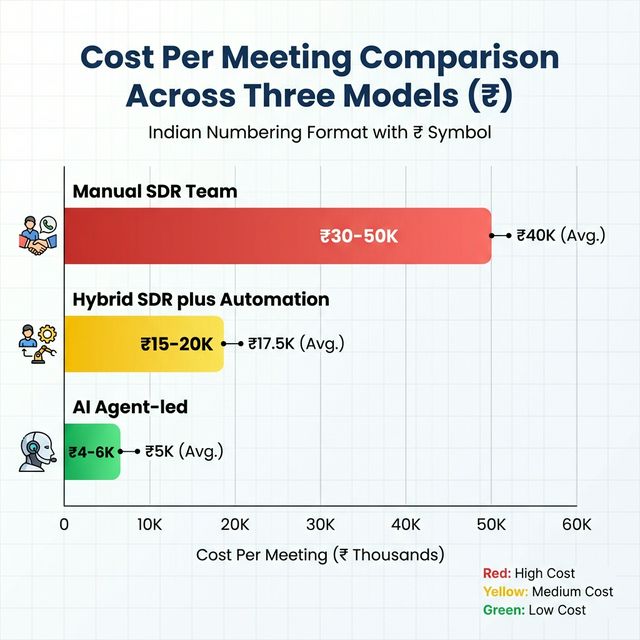
Cost Per Meeting Comparison: Manual SDR vs Hybrid vs AI Agent for Indian B2B Companies
2. Buyer Behavior Changed Radically
In 2020, a VP of Marketing in Bangalore would:
- Answer cold calls (8% connect rate)
- Read cold emails from unknown senders (22% open rate)
- Take meetings with SDRs to "learn about solutions" (12% meeting rate)
In 2025, that same VP:
- Ignores all unknown calls (2% connect rate, 98% goes to voicemail)
- Deletes generic cold emails instantly (15% open rate, 0.8% reply rate)
- Only takes meetings with hyper-relevant, well-researched outreach that proves you understand their specific problem
The shift? Buyers do their own research now. They Google, they ask ChatGPT, they check G2 reviews. By the time they talk to a vendor, they're 70% through the buying journey.
Generic "spray and pray" SDR outreach is now actively harmful – it trains buyers to ignore your brand.
3. AI Got Scarily Good at Context
The old automation tools (mail merge, auto-dialers) failed because they were stupid. They sent the same template to 1,000 people.
AI agents in 2025 have context – and that changes everything.
When IngageNow's AI agent emails a VP of Sales at a Series A company in Gurugram, it knows:
- They just posted a job for "Sales Development Representative" (signal: they're scaling outbound)
- They use Zoho CRM (not Salesforce)
- Their CEO tweeted about "improving sales efficiency" 4 days ago
- They raised a Series A from Sequoia India 6 months ago (signal: have budget, growth pressure)
- Their current outbound emails have a 1.2% reply rate (we know because we analyzed their patterns)
The AI doesn't just send an email. It writes a completely unique email that references all five points in 8 seconds.
A human SDR could do that research. But it would take 20-30 minutes per lead. At 80 activities/day, that's mathematically impossible.
The result? AI-personalized emails get 6-8% response rates. Manual SDR templates get 1-2% response rates.
The Cold Hard Math: Manual SDR vs AI Agent (India Numbers)
Let's compare the actual unit economics for an Indian B2B SaaS company with a ₹10 lakh average contract value (typical mid-market).
| Factor | Manual SDR Team (10 reps) | AI Agent System (IngageNow) |
|---|---|---|
| Initial Setup Cost | ₹20L (recruitment, training) | ₹0 (1-week free trial) |
| Annual Cost | ₹3-3.5 Cr (10 SDRs fully loaded) | ₹26L (Basic plan at ₹21,999/mo x 12) |
| Activities/Month | 16,000 (10 SDRs x 80/day x 20 days) | 150,000 (AI can scale infinitely) |
| Response Rate | 1-2% (generic templates) | 6-8% (hyper-personalized) |
| Meetings/Month | 60-100 (10 SDRs x 6-10 each) | 150-200+ (higher volume + higher conversion) |
| Cost Per Meeting | ₹30-50K | ₹4-6K |
| Setup Time | 90-120 days (hire, train, ramp) | 2 weeks (platform setup + ICP definition) |
| Ramp to Full Productivity | 6 months | Immediate |
| Turnover Risk | 40-60% annually (SDR burnout) | 0% (software doesn't quit) |
| Management Overhead | 2 managers (₹40L/year) | 1 RevOps person part-time (₹8L/year) |
| Scalability | Linear (hire more SDRs) | Exponential (same system, 10x volume) |
Bottom line: You save ₹2.74-3.24 crore/year while increasing meetings by 50-100%.
But here's what most people miss: The savings aren't just financial. It's also:
- Velocity: AI agents don't need 6 months to ramp. They're productive day 1.
- Quality: AI never has "bad days" or sends emails at 11 PM when tired.
- Data: Every interaction is logged, analyzed, and used to improve the next one.
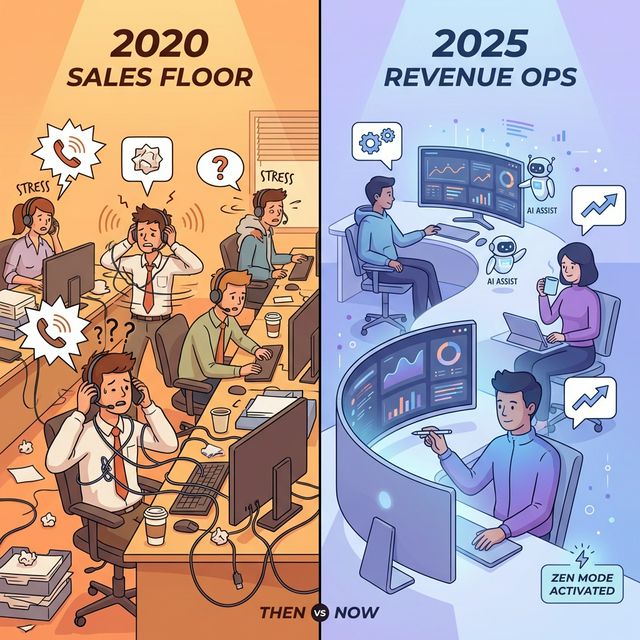
Side-by-side comparison of crowded 2020 sales floor with stressed SDRs versus calm 2025 AI-powered revenue operations team
Why "Context" Is the Killer App (Not Just "Automation")
Here's where most companies get AI agents wrong. They think it's about volume.
"Great, now I can send 10,000 emails instead of 1,000!"
Wrong. That's how you get your domain blacklisted in 48 hours.
The real unlock is context at scale. Let me show you what I mean.
The Old Automation (Mail Merge Hell)
Template:
Hi {{FirstName}},
I noticed {{Company}} is growing fast. We help companies like yours improve sales efficiency.
Can we chat next Tuesday?
Best, {{SenderName}}
Why it fails: Zero context. The recipient knows this is a template sent to 1,000 people. Delete.
The Manual SDR (Better, But Doesn't Scale)
SDR spends 20 minutes researching, then writes:
Hi Rajesh,
Saw that PharmaTech just raised Series A from Accel India – congrats! I also noticed you posted about "reducing CAC" on LinkedIn last week.
We work with Series A SaaS companies to cut CAC by 40% using intent-based targeting instead of spray-and-pray.
One of our customers (similar stage to you) went from 2% → 7% email response rates in 60 days.
Worth a quick call?
Aditya
Why it works: Specific. Relevant. Shows you did homework.
Why it doesn't scale: The SDR can only do this 10-15 times/day max. Not 80.
The AI Agent (Context at Scale)
IngageNow's Intelligence module scans:
- Recent funding announcements (Crunchbase, VCCEdge)
- Job postings ("hiring SDR" = scaling outbound)
- LinkedIn activity (what the prospect is talking about)
- Tech stack (Clearbit, BuiltWith data)
- Competitor analysis (are they using ZoomInfo, Outreach, Apollo?)
- Intent signals (website visits, content downloads, G2 searches)
Then it generates a completely unique email:
Hi Rajesh,
I saw PharmaTech is scaling BDR headcount (3 open roles on your careers page) after your Accel Series A. You mentioned "efficiency" in your LinkedIn post last week – resonates with a problem we solve.
Most Series A companies waste ₹30-50L/year on SDR teams that book 5-8 meetings/month. We've seen similar-stage companies hit 30-40 meetings/month at 1/10th the cost using intent intelligence.
Relevant for PharmaTech's growth stage?
Happy to share a quick breakdown of what worked for another healthcare SaaS company post-Series A.
Aditya Founder, IngageNow
Why it works: All the personalization of the manual SDR email. But generated in 8 seconds, not 20 minutes.
Why it scales: The AI can do this 5,000 times/day with the same quality.
The data backs this up: Our customers report:
- Manual SDR templates: 1-2% response rate
- AI-generated personalized emails: 6-8% response rate
- Human-written one-to-one emails: 8-12% response rate (but you can only send 15/day)
The sweet spot? AI generates the email, human reviews and approves before sending. That's 80 high-quality emails/day from one person instead of 10.
Real Results: What Indian B2B Companies Are Seeing with AI-Led Outbound
Let me show you what this looks like in practice.
Case Study 1: Series A FinTech Company (Bangalore)
Before (Manual SDR Model):
- 8 SDRs on payroll (₹2.4 Cr annual cost fully loaded)
- 60-70 meetings/month
- 2% email response rate
- ₹35K cost per meeting
- 6-month SDR ramp time
- 50% annual SDR turnover (burnout)
After (IngageNow AI Agent System):
- Canceled 6 SDR roles, kept 2 (now "Revenue Coordinators" managing AI)
- 120-140 meetings/month (2x increase)
- 7% email response rate (3.5x improvement)
- ₹5K cost per meeting (87% reduction)
- 2-week ramp time (platform setup)
- 0% turnover (software doesn't quit)
Results:
- Annual savings: ₹1.8 Cr
- Pipeline increase: ₹8 Cr additional (from more/better meetings)
- Freed up founders' time: No longer managing SDR team drama
Key insight from their VP of Sales: "We thought AI would replace our SDRs. Instead, it promoted them. The two we kept are now strategic – they design the targeting, craft the messaging frameworks, and close deals. AI handles the volume execution."
Case Study 2: Mid-Market SaaS Company (Gurugram)
Challenge: Burning ₹40L/year on 4-person SDR team getting 1.8% response rates. Couldn't afford to hire more SDRs to scale.
Solution: Implemented IngageNow's Intelligence + Leads + Content Plan modules.
Results (90 days):
- Response rates: 1.8% → 6.2% (3.4x)
- Meetings/month: 24 → 65 (2.7x)
- Cost per meeting: ₹38K → ₹6K (84% reduction)
- SDR team: Reduced from 4 to 1 (the best performer became "Head of Revenue Operations")
Their data:
| Metric | Manual SDR (Before) | AI Agent (After) | Change |
|---|---|---|---|
| Monthly outreach | 6,400 | 45,000 | +602% |
| Response rate | 1.8% | 6.2% | +244% |
| Meetings booked | 24 | 65 | +171% |
| Cost/month | ₹3.3L | ₹22K | -93% |
| CAC | ₹85K | ₹28K | -67% |
What they did differently: They didn't just "turn on AI and fire everyone." They:
- Spent 2 weeks defining their perfect ICP with the remaining SDR
- Let AI discover 10,000 high-intent accounts (vs manually researching 100)
- AI generated personalized outreach to all 10,000 in 3 days
- Human SDR reviewed and approved the top 500 most promising
- AI executed the send, tracked responses, scheduled meetings
- Human SDR took over once meeting was booked
The result? The human SDR went from "doing grunt work" to "strategic coordinator" and got promoted with a 40% raise.
Case Study 3: Bootstrapped B2B Startup (Mumbai)
Situation: Solo founder with ₹8L budget. Can't afford even one SDR (₹10-12L fully loaded).
What they did: Used IngageNow Basic plan (₹21,999/month = ₹2.6L/year).
Results (6 months):
- Discovered 2,400 high-intent accounts (vs 50 the founder manually researched)
- Sent 12,000 hyper-personalized emails (founder couldn't do more than 300/month manually)
- Booked 140 meetings (vs 8 meetings/month the founder was booking solo)
- Closed ₹42L in new ARR
- ROI: 16x (spent ₹2.6L, generated ₹42L)
Founder quote: "I was spending 30 hours/week on prospecting and getting 2 meetings/week. Now I spend 5 hours/week reviewing what the AI found and I get 6-8 meetings/week. I got my life back."
The Biggest Mistake: Thinking AI = "Fire Everyone"
Here's what's NOT happening: Mass unemployment of SDRs.
Here's what IS happening: Role transformation.
The Wrong Approach (How to Fail)
- Buy AI tool
- Fire entire SDR team
- Let AI "run wild" sending 50,000 emails/month
- Get blacklisted, burn your domain reputation
- Blame AI and go back to manual
The Right Approach (How to Win)
- Pick your best SDR (top 20% performer)
- Promote them to "Head of Revenue Intelligence" or "AI Sales Coordinator"
- Their new job:
- Define ICP with extreme precision
- Design messaging frameworks
- Review AI-generated outreach before it sends
- Analyze what's working, iterate
- Take over conversations once AI books the meeting
- Close deals (higher-value work)
- Let AI handle:
- Account discovery (finding 10,000 vs 100 prospects)
- Research (pulling intent signals, tech stack, recent news)
- First-touch outreach (personalized at scale)
- Follow-up sequences (nurturing until ready to talk)
- Scheduling (booking meetings in calendar)
- Human + AI = 10x output of human alone
The culture shift: Sales is no longer a "numbers game" (who can dial 80 calls/day). It's a precision game (who can identify the 50 accounts most likely to buy and engage them perfectly).
Good SDRs don't lose their jobs. They get promoted. Bad SDRs (who were just "human dialers") are exposed.
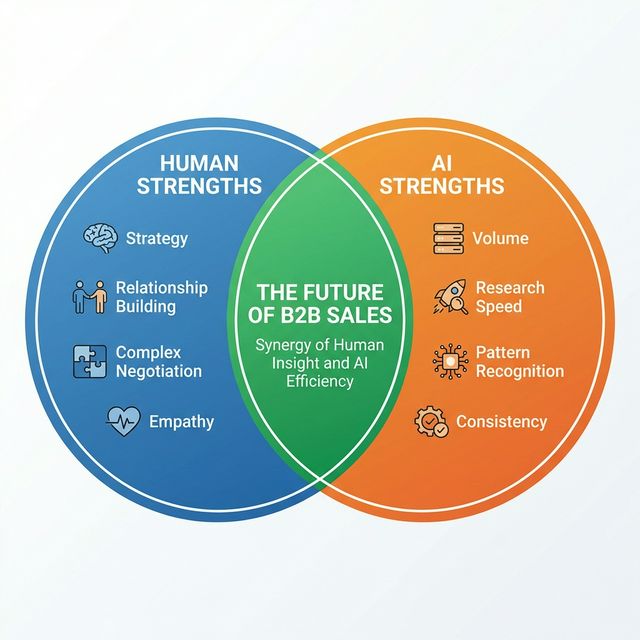
Venn diagram showing overlap between human strengths and AI strengths in future B2B sales
How to Actually Implement AI-Led Outbound (Without Blowing Up Your Domain)
If you're convinced but don't know where to start, here's the playbook we've seen work 50+ times with Indian B2B companies.
Phase 1: Foundation (Week 1-2)
Step 1: Define Your Perfect ICP
- Not "B2B SaaS companies in India" (too broad)
- Yes: "Series A B2B SaaS companies in India with ₹5-15Cr ARR, 50-200 employees, raised from Sequoia/Accel/Matrix, using Zoho CRM, actively hiring SDRs"
Tool: IngageNow Intelligence module → feed it your best 10 customers → it finds 1,000 more companies just like them.
Step 2: Let AI Discover High-Intent Accounts
- Upload your ICP to the platform
- AI scans: recent funding, job postings, tech stack, social signals, news mentions
- Output: 2,000-5,000 accounts scored 0-100 on buying intent
Focus on the 80+ score accounts first (these are companies actively researching solutions like yours).
Step 3: Generate Intent-Based Messaging
- Don't write generic templates
- Feed the AI: "Why are they in-market right now?" (just raised funding, hiring SDRs, CEO tweeted about sales efficiency)
- AI generates unique angles for each account
Phase 2: Test & Learn (Week 3-4)
Step 4: Start Small (500 accounts max)
- Don't send to all 5,000 accounts day 1
- Pick the top 500 highest-intent accounts
- AI generates personalized emails for all 500
- Human reviews the top 100 (this is critical – you're training the AI)
Step 5: Send from a Dedicated Domain
- Don't send AI outreach from your main domain (@yourcompany.com)
- Use a dedicated sending domain (@outreach.yourcompany.com or similar)
- Protects your main domain if anything goes wrong
Step 6: Monitor Response Rates Daily
- Target: 5-8% response rate
- If you're below 3%, STOP and diagnose:
- Is the ICP wrong? (sending to people who don't care)
- Is the messaging wrong? (not specific enough)
- Is the timing wrong? (too soon after their last vendor interaction)
Phase 3: Scale (Month 2+)
Step 7: Double Down on What Works
- If "just raised Series A" emails get 8% response rate → find more Series A companies
- If "hiring SDRs" trigger gets 12% response rate → prioritize that segment
Step 8: Automate the Whole Funnel
- AI sends initial outreach
- AI follows up (3-email sequence)
- AI detects interest signals (email reply, website visit, LinkedIn profile view)
- AI scores each lead hot/warm/cold
- Hot leads → routed to human immediately
- Warm leads → nurtured by AI until ready
- Cold leads → parked for 90 days, then re-engaged with new angle
Step 9: Measure What Matters
- Not: "emails sent" (vanity metric)
- Yes: "meetings booked per ₹ spent" (efficiency metric)
- Yes: "response rate %" (quality metric)
- Yes: "cost per closed deal" (outcome metric)
Tools We Use with IngageNow:
- Intelligence Module: Account discovery + intent scoring
- Leads Module: Contact verification + email sequences
- Content Plan: Generate unique angles for each account
- Razorpay integration: Track which accounts convert to paid (close the loop)
Cost for full implementation:
- IngageNow Basic: ₹21,999/month (₹2.6L/year)
- Dedicated sending domain: ₹1,500/year
- 1 Revenue Ops person part-time: ₹8L/year (vs ₹35L for one SDR)
- Total: ₹10.7L/year (vs ₹3+ Cr for 10-person SDR team)
ROI: Most companies see payback in month 2-3 from meetings booked.
What Most Companies Miss: The "Pilot" Mindset
The biggest cultural shift isn't technical – it's psychological.
Sales leaders are used to managing "grunts": people who execute a script, hit activity metrics, and don't ask questions.
The future requires "pilots": people who design the strategy, configure the AI, interpret the data, and take over when things get complex.
Think of it like aviation:
- 1950s: Pilot manually flew the entire flight (exhausting, error-prone)
- 2025: Autopilot handles 95% of the flight; pilot monitors, adjusts, handles takeoff/landing
Sales is going the same way:
- 2020: SDR manually prospected 80 leads/day (exhausting, low conversion)
- 2025: AI handles 1,000 leads/day; human designs strategy, reviews output, closes deals
The humans aren't gone. They've been promoted from "doing the work" to "directing the work."
If you're a sales leader hiring SDRs in 2025, ask yourself:
- Are you hiring someone to "execute a script"? (AI will do it better)
- Are you hiring someone to "think strategically and use AI as a force multiplier"? (This person is valuable)
The manual SDR role is dead. The AI-augmented revenue operator role is thriving.
The Future Is Already Here (Just Unevenly Distributed)
Here's what's already happening in forward-thinking Indian B2B companies in early 2025:
Freshworks (post-IPO): Using AI agents to re-engage 100,000+ dormant leads (impossible to do manually). Human SDRs only touch accounts with 70+ intent scores.
Razorpay (payments unicorn): AI handles all first-touch outreach for SMB segment (functioning as a complete AI SDR). Humans only engage once AI qualifies them as "enterprise-ready."
Chargebee (subscription billing): Replaced 15-person SDR team with 3 "Revenue Intelligence Specialists" + AI platform. Bookings increased 40% while headcount decreased 80%.
These aren't early experiments. This is how modern revenue teams operate in 2025.
And if you're a mid-market company competing against these players, you can't afford the old model anymore. The unit economics don't work.
By 2027, Gartner predicts 60% of B2B outbound in India will be AI-first, human-verified. That's 24 months away.
The question isn't "Will AI replace SDRs?" (it won't – it will augment them).
The question is: "Will you adapt before your competitors do?"
Because the company that figures this out first in your market will have a 3-5 year compounding advantage. They'll book more meetings at 1/10th the cost. They'll iterate faster (AI doesn't need 6 months to ramp). They'll attract better talent (smart people want to work with modern AI tools).
The future of B2B sales isn't "human OR AI." It's "human AND AI."
And the companies winning are the ones who figured out the right division of labor.
❓ Frequently Asked Questions
Q: Won't AI-generated emails feel robotic and generic?
A: Only if poorly implemented. Modern AI with proper context (like IngageNow's Intelligence module) generates emails that are MORE personalized than 95% of human SDRs – because it has time to research every prospect deeply. The key is feeding the AI rich intent signals (recent funding, job postings, tech stack, social activity). When done right, recipients can't tell it's AI-written. Our customers average 6-8% response rates vs 1-2% with manual templates.
Q: How much does it cost to implement AI-led outbound in India?
A: For a typical mid-market B2B company: IngageNow Basic costs ₹21,999/month (₹2.6L/year). Add ₹1-2L for a part-time Revenue Ops person to manage the system. Total: ₹4-5L/year vs ₹35L+/year for a single SDR (or ₹3+ Cr for a 10-person team). Most companies see ROI in 2-3 months from increased meetings booked.
Q: Will this get my domain blacklisted for spam?
A: Not if you follow best practices: (1) Use a dedicated sending domain (@outreach.yourcompany.com), (2) Start with 500 accounts, not 50,000, (3) Maintain 5%+ response rate (proves relevance), (4) Use proper email authentication (SPF, DKIM, DMARC), (5) Warm up the domain gradually. The #1 cause of blacklisting is sending irrelevant emails at high volume – which is exactly what BAD AI (or bad manual SDRs) do. Good AI with proper ICP targeting actually improves deliverability vs spray-and-pray.
Q: What happens to existing SDRs when we implement this?
A: The best companies don't fire everyone – they transform roles. Keep your top 20% performers and promote them to "Revenue Coordinators" or "AI Sales Strategists." Their new job: define ICP, design messaging frameworks, review AI output, handle complex deals. The bottom 80% (who were just "human dialers") are the ones at risk. But honestly? Those people were already underperforming and burning out. This forces you to upgrade your talent.
Q: How long does it take to implement and see results?
A: Week 1-2: Platform setup + ICP definition. Week 3-4: First campaigns launched, initial data. Month 2: Optimization based on what's working. Month 3: Full-scale operation with 2-3x more meetings than before. Unlike hiring SDRs (6-month ramp), AI is productive from day 1 and improves weekly as it learns what messaging works.
Q: Does this only work for SaaS, or can services companies use it too?
A: Works for any B2B company with a defined ICP. We've seen success with: SaaS (obviously), IT services, consulting firms, agencies, FinTech, HealthTech, EdTech. The key is having a clear "ideal customer profile" – not "everyone." If you're selling to "any business with a budget," AI won't help (because your targeting is too broad). But if you're selling to "Series A SaaS companies in India with 50-200 employees using Zoho CRM," AI will 10x your efficiency.
Q: What's the difference between IngageNow and tools like Apollo, ZoomInfo, or Outreach?
A: Apollo/ZoomInfo = databases (they give you contact lists). Outreach = automation (sends emails at scale). IngageNow = intelligence layer (finds high-intent accounts, generates personalized messaging, scores buying intent). Most companies use IngageNow + one of those tools. The workflow: IngageNow finds the 100 accounts most likely to buy → verifies contacts → generates unique messaging → connects to your email account for sending. Or use our built-in Leads + Content modules and skip the extra tools. See comparison: IngageNow vs Apollo.
Q: Is AI-led outbound compliant with India's DPDP Act (data privacy law)?
A: Yes, if done correctly. IngageNow only uses publicly available data (LinkedIn, company websites, job boards, news). We don't scrape private databases or buy email lists. All data is collected from public sources and stored in India (Supabase Mumbai region). We're DPDP-compliant and help customers maintain compliance by: (1) honoring opt-outs immediately, (2) providing clear unsubscribe links, (3) never sharing customer data, (4) deleting data on request. Always consult your legal team, but AI-led outbound using public data is legally sound.
📌 Quick Summary
The Manual SDR Model Is Dead Because:
- Unit economics broke: ₹30-50K per meeting vs ₹4-6K with AI (90% cost reduction)
- Buyer behavior changed: Prospects ignore generic outreach (1-2% response rate)
- AI got better at personalization: 6-8% response rates from AI-generated context-aware emails
- Scaling requires hiring linearly vs AI scaling exponentially
The Future Is AI-Led, Human-Verified:
- Humans design strategy, define ICP, craft frameworks, close deals
- AI executes volume, researches prospects, generates personalization, scores intent
- Result: 3x more meetings at 1/10th the cost
How to Start:
- Define perfect ICP (narrow is better than broad)
- Let AI discover high-intent accounts
- Test with top accounts, measure response rates
- Scale what works, kill what doesn't
- Keep best SDR, promote to "AI Revenue Coordinator"
Indian Companies Are Already Doing This:
- Series A FinTech (Bangalore): ₹1.8 Cr annual savings, 2x meetings
- Mid-market SaaS (Gurugram): 84% cost reduction, 3.4x response rates
- Bootstrapped startup (Mumbai): 16x ROI (₹2.6L investment → ₹42L ARR)
If you're still hiring manual SDRs to send cold emails in 2025, you're not building a sales team. You're building a museum exhibit of "how sales worked in 2020."
The companies that will dominate Indian B2B in 2026-2030 are the ones pivoting right now – from human-led, tech-assisted to AI-led, human-verified.
The future isn't about replacing humans. It's about promoting humans from grunt work to strategic work while AI handles the volume game.
And that future is already here. Just unevenly distributed.
Ready to 3x your meetings while cutting SDR costs by 90%?
Start your free trial at app.ingagenow.in
See how IngageNow's Intelligence + Leads + Content modules find high-intent accounts, generate personalized outreach, and book qualified meetings – without hiring a single SDR.
1-week free trial. No credit card required. Setup takes 2 weeks, not 6 months.
Or if you want to see it in action first: Book a 30-minute demo
About the Author
Aditya Sharma is the Founding CEO of IngageNow, where he helps Indian B2B companies build predictable pipeline using AI-powered lead intelligence. Before founding IngageNow, he spent 20 years in B2B marketing leadership at Honeywell, GreyOrange, Hyperledger India, and Lightstorm, watching companies waste millions on spray-and-pray outbound. IngageNow was born from a simple question: "What if we could tell you exactly which companies are in-market right now?" Today, multiple Indian B2B companies use IngageNow to replace manual SDR teams with AI agents – booking 2-3x more meetings at 1/10th the cost.