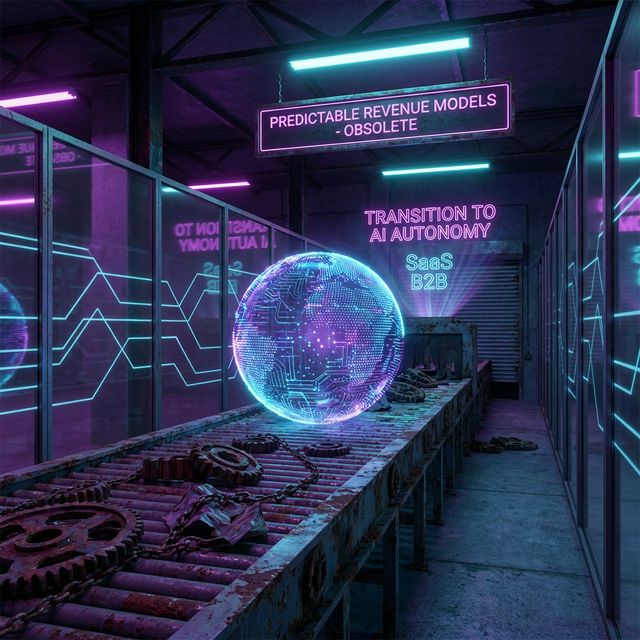
The Death of 'Predictable Revenue': Why the Aaron Ross Model is Obsolete in India's Agentic Age
Published: February 23, 2026 | Updated: February 23, 2026 By: Aditya Sharma, Founding CEO of IngageNow
Fifteen years ago, Aaron Ross published Predictable Revenue, and it became the bible of B2B sales. Every founder I met in Gurugram between 2015 and 2022 had a dog-eared copy on their desk. Including me.
His methodology was elegant in its simplicity: build a factory-line sales machine. Separate the roles. Specialize. SDRs prospect and generate leads. Account Executives take meetings and close deals. Customer Success Managers onboard and retain clients. Measure the conversion at each stage. Scale linearly by adding more SDRs.
It worked brilliantly. It built Salesforce into a ₹10,000 Cr company. It powered HubSpot's IPO. It became the default operating system for a generation of B2B startups.
Then everyone started doing it. And the model imploded.
I know this because I ran this playbook at multiple companies over 20 years. I watched it work beautifully in 2015. I watched it strain in 2019. And I watched it completely break in 2023 when we tried to scale outbound at GreyOrange and the unit economics simply stopped making sense.
That's when I realized: the Predictable Revenue model was built on economic assumptions that no longer exist. And for Indian B2B companies in 2026, following that playbook is no longer a growth strategy. It's a financial liability.
🎯 Key Takeaways:
- The Predictable Revenue model assumed cheap outbound attention (15% connect rates, 5-8% reply rates) – those numbers have collapsed to 2-3% and 1-2% respectively
- Indian B2B companies following the Aaron Ross playbook spend ₹3-5 Cr/year on SDR teams generating 60-100 meetings/month
- The Agentic Model replaces the assembly line with an intelligence engine: same pipeline at 1/10th the cost
- "Predictability" in 2026 comes from data-driven AI engines, not human activity quotas
- Companies transitioning from the Ross model to AI-augmented outbound report 3x pipeline at 87% lower cost
Why the Assembly Line Collapsed
The Predictable Revenue model was built on a foundational economic assumption: that outbound attention is cheap.
In 2011, receiving a semi-personalized cold email from a B2B vendor was a novelty. Buyers read them. Cold call connect rates hovered around 12-15%. You could accurately predict: dump 1,000 leads into the top, get 8-12 closed-won deals out the bottom. Simple math, repeatable process.
Here's what changed:
The Attention Economy Inverted
| Metric | 2011 (When the Book Was Written) | 2026 (Today) | Decline |
|---|---|---|---|
| Cold email open rate | 35-40% | 15-18% | -55% |
| Cold email reply rate | 5-8% | 1-2% | -75% |
| Cold call connect rate | 12-15% | 2-3% | -80% |
| Buyer willingness to take cold meetings | High | Very low | -85% |
| SDR tools needed per rep | 2-3 | 6-8 | +200% |
| SDR cost per meeting (India) | ₹5-8K | ₹30-50K | +500% |
The average B2B executive in Bangalore or Mumbai now receives 150+ automated cold emails daily. They have sophisticated spam filters, gatekeepers, and they simply ignore unknown callers. The "predictable" math that powered the Ross model has become wildly unpredictable.
The Volume Trap
The assembly line model responded to declining reply rates the only way it knew how: by violently increasing volume.
If 1,000 emails yields 2 deals now instead of 10, just send 5,000 emails.
This created the "Spray and Pray" era. SDRs blasted thousands of generic, low-effort emails per day to hit activity quotas. The predictable consequences:
- Corporate email domains burned (deliverability tanked)
- Prospects infuriated (your brand becomes synonymous with spam)
- Industry-wide conversion rates dropped further (everyone's outreach got worse)
- Buyers installed more aggressive blockers (reinforcing the cycle)
The Predictable Revenue playbook didn't just stop working. It created a negative flywheel that made outbound harder for everyone.
The Personalization Paradox
Here's the cruel irony: the only way to stand out in a 150-email inbox is hyper-personalization. But the Ross model was built for standardization.
A human SDR faces an impossible choice:
- Option A: Spend 20 minutes researching a prospect to write a truly personalized email. Send 24 emails/day. Not enough volume to fill a pipeline.
- Option B: Spray 200 template emails/day. High volume but zero relevance. Gets marked as spam.
There is no Option C for a human. The Ross model has no solution for this paradox.
Why the Model is Especially Broken for Indian B2B
While the Ross model is struggling globally, it's particularly broken for Indian B2B companies. Here's why:
1. Deal Sizes Are Smaller
A typical Indian mid-market SaaS deal is ₹10-25L ACV. In the US, equivalent deals are $50-100K. The Ross model's unit economics were designed for $50K+ deals.
At ₹10-25L ACV with ₹30-50K cost per meeting and a 5-8 meeting sales cycle, you're spending ₹1.5-4L to acquire a customer worth ₹10-25L. That's 15-40% of first-year revenue going just to SDR costs. The math barely works (and often doesn't).
2. SDR Labor Costs are Rising
India's "labor arbitrage" for SDRs isn't what it used to be. A competent SDR in Gurugram or Bangalore now commands ₹50-70L OTE. Add tools, management, and overhead, and you're at ₹1.2-1.5 Cr per rep. The cost advantage over US SDRs has narrowed significantly.
3. Talent Retention is Brutal
SDR turnover in India runs 40-60% annually (vs 25-35% in the US). The combination of low starting pay, high rejection rates, and abundant job opportunities in India's booming tech market means you're constantly losing reps right when they become productive.
4. Indian Buyers Are Harder to Reach
Cold calling in India has a 1.5-2% connect rate (even lower than the US average of 2-3%). Decision-makers in Indian companies are insulated by multiple layers: PAs, junior team members, and a cultural norm of not taking unsolicited calls. The entire top-of-funnel engine of the Ross model – cold calls – is nearly non-functional in the Indian market.
The Agentic Model: What Replaces the Assembly Line
If the Ross model is an assembly line, the Agentic Model is an intelligence engine.
The difference is fundamental:
| Dimension | Predictable Revenue (Ross Model) | Agentic Model (IngageNow) |
|---|---|---|
| Core engine | Human labor (SDRs) | AI agents + data |
| Scaling mechanism | Hire more people (linear) | Configure the AI (exponential) |
| Personalization | Template-based (low quality) | Context-driven (37 intent signals) |
| Predictability source | Activity quotas (80 calls/day) | Data-driven scoring (intent + signal) |
| Cost structure | Variable (scales with headcount) | Fixed (software license) |
| Time to ramp | 3-6 months per SDR | 2 weeks (platform setup) |
| Knowledge retention | Lost at churn (40-60% annual) | Compounding (AI never forgets) |
| Volume capacity | 80-100 activities/day per person | 3,000-5,000/day per agent |
| Quality at scale | Degrades with volume | Constant regardless of volume |
| Operating cost | ₹3-5 Cr/year (10 SDRs + mgmt) | ₹30-45L/year (AI + 1-2 humans) |
How It Works
With a platform like IngageNow, you replace the factory floor with a command center:
-
Define the ICP with extreme precision – not "B2B SaaS in India" but "Series A-B SaaS with ₹5-25Cr ARR, 50-200 employees, using Zoho CRM, actively hiring SDRs, CEO posted about growth efficiency in last 30 days"
-
Set behavioral intent triggers – "Only target companies that: raised funding in last 6 months, OR posted SDR jobs, OR CEO mentioned efficiency on LinkedIn, OR recently adopted a new CRM"
-
Unleash the agents – IngageNow's Intelligence module scans 37 intent parameters, scores accounts 0-100, and generates hyper-personalized outreach referencing each prospect's specific signals
-
Human steps in only for qualified conversations – the AE takes over when a pre-qualified prospect requests a meeting, not before
The human isn't doing the prospecting. They're designing the strategy and closing deals. Everything between ICP definition and meeting booking is handled by AI.
Real Results: Companies That Left Aaron Ross Behind
Case Study 1: Series B SaaS (Bangalore)
The Ross Model (Before):
- 8 SDRs + 1 Manager, ₹2.4 Cr annual cost
- Activity quotas: 80 activities/day per SDR
- Predictable? Barely. Monthly meetings fluctuated between 40-90 depending on SDR performance, vacation, turnover
- 1.5% email response rate
- ₹35K cost per meeting
The Agentic Model (After):
- 1 Revenue Strategy Lead + IngageNow, ₹35L annual cost
- No activity quotas. Signal-based targeting
- Highly predictable: 120-150 meetings/month (consistent, no fluctuation)
- 7% email response rate
- ₹4.5K cost per meeting
The CEO's comment: "Aaron Ross's book told us to build an assembly line. IngageNow told us to build a sniper team. The assembly line was expensively unpredictable. The sniper team is cheaply precise."
Case Study 2: Bootstrapped B2B (Gurugram)
Challenge: Could not afford the Ross model at all. A single SDR at ₹50L + tools was double their yearly marketing budget of ₹25L.
Solution: IngageNow Basic at ₹2.6L/year. Founder spent 5 hours/week managing AI.
Results (6 months):
- 2,400 high-intent accounts discovered (vs 40 the founder manually found)
- 12,000 personalized emails sent (vs 200/month manually)
- 140 meetings booked (vs 8/month solo prospecting)
- ₹42L in new ARR, 16x ROI
The Ross model would have been impossible for this company. The Agentic Model made them competitive with companies 10x their size.
The New Predictability: Data Replaces Activity Quotas
Here's the profound shift: predictability in the Agentic Age comes from data quality, not human activity volume.
In the Ross model, predictability meant: "If my 10 SDRs each make 80 activities/day, I'll get X meetings." But human performance varies wildly (sick days, burnout, turnover, motivation).
In the Agentic Model, predictability means: "If I target companies with intent scores above 80, my response rate will be 6-8% and I'll book Y meetings per Z outreach." The AI performs identically every single day.
What makes AI-driven outbound more predictable than human-driven:
- No variance – AI doesn't have bad days, sick days, or motivation dips
- Instant feedback loops – if response rates drop, the system adjusts targeting and messaging in real-time
- Compounding intelligence – every interaction makes the system smarter (vs human SDRs who leave and take knowledge with them)
- Dial-up, dial-down – need more pipeline? Increase the daily outreach volume from 1,000 to 5,000. Need less? Scale down. No hiring, no firing, no ramp delays
You don't need the old playbook anymore. You just need data, intelligence, and the willingness to let software do what it does best: scale without degrading quality.
❓ Frequently Asked Questions
Q: Is the Predictable Revenue model completely dead?
A: The principles (specialization, measurement, process) still matter. But the implementation (hiring armies of SDRs to make cold calls and send templates) is broken. The Agentic Model preserves the principles while replacing the human labor bottleneck with AI that can personalize at scale.
Q: Doesn't Aaron Ross himself acknowledge the model needs updating?
A: Yes. Even Ross has evolved his thinking. But most Indian B2B companies are still running the 2011 version of his playbook – hiring SDRs, assigning activity quotas, and hoping for the best. The framework needs more than an update; it needs a fundamental rearchitecture.
Q: Can AI really replace the human element in sales development?
A: AI replaces the grunt work (research, list building, first-touch outreach, follow-up sequences). Humans handle the strategic work (ICP definition, messaging strategy, complex negotiations, relationship building). The division of labor shifts, but humans don't disappear – they get promoted from "dialing phones" to "designing strategy."
Q: What's the transition cost from Ross model to Agentic model?
A: IngageNow Basic costs ₹21,999/month (₹2.6L/year). Most companies run AI parallel to their existing SDR team for 4-6 weeks, compare results, then gradually transition. The transition typically saves ₹1.5-3 Cr/year while increasing pipeline 2-3x. ROI is positive within 2-3 months.
Q: How does this work for companies that sell through relationships, not outbound?
A: Even relationship-driven companies need top-of-funnel pipeline. AI handles the discovery and initial outreach (finding the right people, getting the conversation started). Once the relationship begins, humans take over. Most B2B deals in India still close on relationships – but finding those relationships at scale is where AI excels.
Q: Is this just automation, or is it fundamentally different?
A: Fundamentally different. Old automation (mail merge, auto-dialers) was "stupid automation" – same template, 1,000 people. AI agents have context. They research each prospect using 37 intent signals, generate unique messaging, adapt based on response data, and score accounts dynamically. It's the difference between a spam cannon and a precision sniper.
📌 Quick Summary
Why Predictable Revenue Died:
- Built on 2011 assumptions: 12-15% call connect rates, 5-8% email reply rates
- 2026 reality: 2-3% connect rates, 1-2% reply rates – a 75-80% decline
- SDR response to declining rates: increase volume (Spray and Pray) – made everything worse
- Personalization paradox: quality or quantity, never both (for humans)
Why It's Especially Broken in India:
- Smaller deal sizes (₹10-25L ACV vs $50-100K in US)
- Rising SDR costs (₹1.2-1.5 Cr fully loaded)
- 40-60% annual turnover
- 1.5-2% cold call connect rate (even lower than US)
The Agentic Alternative:
- Replace human labor bottleneck with AI intelligence engine
- 37 intent signals per prospect (vs 3-5 from human SDRs)
- 3,000-5,000 activities/day (vs 80-100 from humans)
- ₹30-45L/year (vs ₹3-5 Cr for 10 SDRs + management)
The New Predictability:
- Data-driven scoring, not human activity quotas
- Consistent daily output (no variance from burnout, sickness, turnover)
- Compounding intelligence (system gets smarter, never loses knowledge at churn)
The Predictable Revenue playbook was revolutionary in its time. Aaron Ross deserves enormous credit for professionalizing sales development. But the economic assumptions it was built on have evaporated.
The playbook for Indian B2B in 2026 isn't about building a bigger assembly line. It's about building a smarter intelligence engine.
The companies that will dominate the next decade aren't the ones with the most SDRs. They're the ones with the best data, the sharpest targeting, and AI that can turn intent signals into qualified meetings at a fraction of the cost.
Ready to move from the assembly line to the intelligence engine?
Start your free trial at app.ingagenow.in
See why Indian B2B companies are leaving the Predictable Revenue model behind for AI-powered pipeline generation.
1-week free trial. No credit card required.
Or talk to us: Book a 30-minute demo
About the Author
Aditya Sharma is the Founding CEO of IngageNow. He spent 20 years running the Predictable Revenue playbook at Honeywell, GreyOrange, and Lightstorm before realizing the model was broken. IngageNow was built to replace the assembly line with an intelligence engine – helping Indian B2B companies build predictable pipeline without predictable headcount costs.