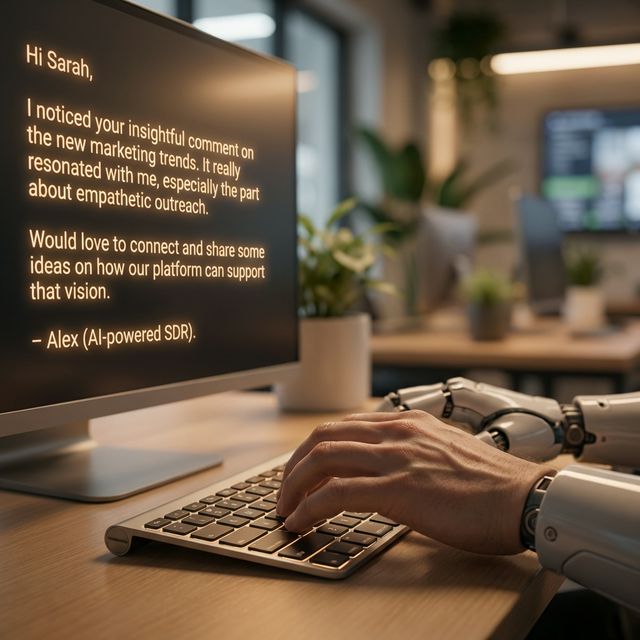
Wait, Did a Robot Write This? The Psychology of High-Converting Autonomous Outreach
We are currently living through an absolute epidemic of "AI-Brain" content.
You know exactly what it looks like. It’s the LinkedIn post with entirely too many rocket-ship emojis. It’s the cold email that starts with, "I hope this email finds you well," uses words like "delve" and "synergy," and awkwardly concludes with, "In today's fast-paced digital landscape..."
Buyers are exhausted by it. Within the last 24 months, B2B decision-makers have developed a highly tuned, almost subconscious radar for AI-generated text. The second that radar is triggered, the email doesn't just get ignored; it gets actively resented. If your outbound automated sequencing triggers that "robot" feeling, your prospect will delete the email without even finishing the first paragraph.
Engineering Empathy, Not Just Grammar
When we built the copywriting engine for IngageNow, our goal was not simply to build an AI that could write grammatically flawless English sentences. Grammar is a commodity.
Our goal was fundamentally different: we needed to build an autonomous agent that deeply understood the nuanced psychology of B2B enterprise sales.
To prevent our agents from sounding like polite but soulless corporate robots, we had to engineer them with very specific, counter-intuitive psychological guardrails. We had to teach the AI how to be imperfect.
1. The Power of Aggressive Brevity
Robots love to over-explain. Because LLMs are trained on massive corpuses of text, their default behavior is to provide comprehensive, multi-paragraph answers.
Humans, however, are violently busy. When a VP of Sales opens an email on their iPhone while walking between meetings, a 400-word essay is an immediate deletion.
IngageNow agents are strictly trained against verbosity. They are given hard physical constraints. They must state the contextual observation, state the specific hypothesized value, and make a low-friction ask—all in under 75 words. Brevity signals respect for the buyer's time, which is a uniquely human trait.
2. Conversational Imperfection
Perfectly structured corporate-speak is a dead giveaway of automation. Real executives do not write like PR machines.
Our engine intentionally uses conversational tone over formal tone. It is prompted to use contractions ("I'm", "We're"). It is explicitly banned from using heavy, multi-syllabic adjectives like "revolutionary" or "unprecedented." It writes using short, punchy sentences. The ultimate goal is to make the email look exactly like it was quickly typed with a single thumb by a busy founder waiting in an airport lounge.
3. The Psychology of the "Soft Ask"
AI tools trained on legacy sales data always default to the hard close. They end emails like this: "Do you have 30 minutes for a discovery call next Tuesday at 2 PM to discuss your synergies?"
That creates immediate psychological friction. A human doesn't want to owe a stranger 30 minutes of their life.
Instead, IngageNow agents are trained to use the "Soft Ask"—gauging interest rather than demanding a calendar slot.
"Is this something you guys are dealing with right now?" "Worth an asynchronous chat over email?" "Open to seeing a 2-minute Loom detailing how we fixed this for [Competitor]?"
By lowering the barrier to entry, the reply rates skyrocket.
The "Edit Distance" Feedback Loop
Perhaps the most crucial psychological feature of IngageNow is that it does not force you into a generic "IngageNow Voice."
During onboarding, the platform ingests your historical CRM data and analyzes the specific cold emails that actually resulted in closed-won deals for your company. It learns your specific industry acronyms, your cadence, and your unique brand personality.
Furthermore, it learns in real-time. We use a metric called "Edit Distance." When the AI drafts an email for your review, and you manually tweak a few words before hitting send, the agent mathematically analyzes exactly what you changed. If you consistently delete the word "platform" and replace it with "engine," the AI permanently adopts that preference.
It learns exactly how you prefer to communicate with your buyers. By combining deep personalization with conversational psychology, your prospects will never ask, "Did a robot write this?"
They will simply ask you for a product demo.